
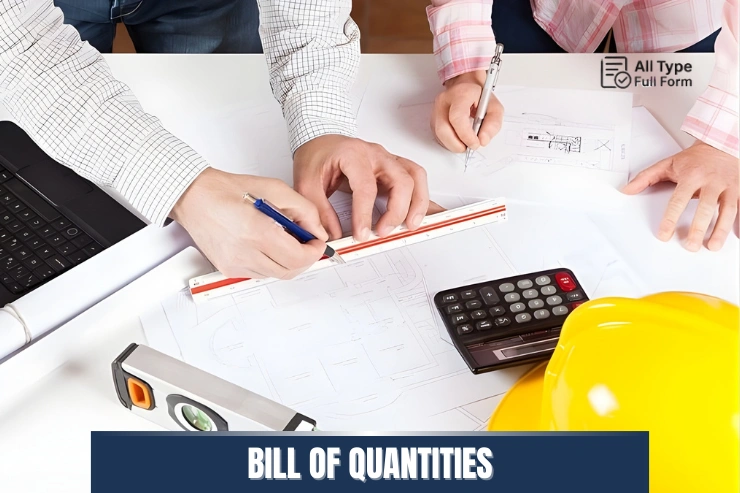
The BOQ full form is a term frequently encountered in construction, engineering, and even academic projects; however, many individuals do not fully grasp its significance in practical planning. Understanding this full form enables students, professionals, and anyone managing budgets or materials to make more informed decisions and prevent expensive errors.
In essence, BOQ serves as a roadmap that directs a project from inception to completion. Grasping this concept not only enhances your knowledge but also provides a practical advantage in daily tasks and studies—making it an essential term that merits exploration.
Quick Stats:
| Metric | Statistics |
|---|---|
| Global construction market size (2024) | $14.8 trillion |
| Projects using BOQ documentation | 85-90% of large-scale projects |
| Average cost accuracy with proper BOQ | 92-95% |
| Time saved in procurement process | 30-40% |
| Reduction in project disputes | Up to 60% |
| Industries primarily using BOQ | Construction, Engineering, Infrastructure, Electrical |
What Exactly Is BOQ? Breaking Down the Basics
The BOQ full form – Bill of Quantities – represents a detailed document that lists every single item required for a construction or engineering project, complete with descriptions, quantities, and units of measurement. It’s like a super-detailed shopping list, except instead of “2 dozen eggs,” you’re looking at “2,500 cubic meters of M25 grade concrete.”
Here’s the beautiful part: BOQ isn’t just for construction sites with hard hats and cement mixers. You’ll encounter it in:
- BOQ in tender processes (the backbone of competitive bidding)
- BOQ in civil engineering (roads, bridges, dams – the whole infrastructure gang)
- BOQ full form in electrical projects (every wire, switch, and circuit breaker counted)
- BOQ full form in purchase departments (procurement’s best friend)
- BOQ in engineering projects across all disciplines
Why Should You Care About BOQ?
Picture this: You’re building your dream house. Without a proper BOQ, your contractor might “forget” to include bathroom fixtures in the quote. Surprise! That’s an extra $5,000 you weren’t planning to spend. With a detailed BOQ? Every toilet, every faucet, every tile is accounted for upfront. No surprises, no budget explosions, no midnight panic attacks.
The Anatomy of a BOQ: What’s Inside This Magical Document?
A standard boq format typically includes these essential components:
1. Item Number and Description
Every single component gets its own line item with a crystal-clear description. We’re talking forensic-level detail here – not just “cement,” but “Ordinary Portland Cement, Grade 53, conforming to IS 12269:2013.”
2. Unit of Measurement
Is it measured in cubic meters? Square feet? Per piece? Kilograms? The unit matters because “1000” without context could mean 1000 bricks or 1000 tons of steel – slightly different price tags!
3. Quantity Required
This is where the magic happens. Quantity surveyors (the unsung heroes of construction) calculate exactly how much of everything you need, accounting for wastage, overlap, and those “just in case” scenarios.
4. Rate Per Unit
The price tag for each unit. This is where contractors fill in their rates during bidding, making the BOQ a level playing field for fair comparison.
5. Total Amount
Simple math: Quantity × Rate = Total. But when you’re dealing with thousands of items, this becomes your project’s financial roadmap.
6. Remarks/Specifications
The fine print that saves lives (and lawsuits). Special requirements, quality standards, installation methods – it all goes here.
BOQ in Different Industries: It’s Everywhere!
BOQ Full Form in Construction and Civil Engineering
In the construction world, boq full form in civil engineering represents the holy grail of project documentation. Whether you’re building highways or housing complexes, the BOQ breaks down everything from excavation volumes to roofing materials.
Real-world example: The Delhi Metro Project utilized comprehensive BOQs spanning thousands of pages, detailing everything from tunnel boring machines to platform tiles. This meticulous documentation helped keep one of the world’s largest metro projects on track (pun intended!).
BOQ Full Form in Electrical Projects
When we talk about boq full form in electrical work, we’re diving into a specialized realm. Every cable, conduit, switch, panel, and light fixture gets documented. Electrical BOQs often include:
- Wire specifications (gauge, insulation type, voltage rating)
- Fixture details (lumens, wattage, IP ratings)
- Protection equipment (MCBs, ELCBs, earthing systems)
- Installation accessories (clips, clamps, junction boxes)
Expert Insight: According to chartered electrical engineer Rajesh Sharma, “A well-prepared electrical BOQ can reduce on-site confusion by 70%. When electricians know exactly what materials are coming and when, workflow becomes seamless.”
BOQ in Tender Processes
The phrase “boq in tender” is music to procurement officers’ ears. Here’s why: when multiple contractors bid for a project, the BOQ ensures everyone’s quoting for the exact same scope of work. No apples-to-oranges comparisons, no hidden costs lurking in vague descriptions.
The tender process with BOQ looks like this:
- Client prepares detailed BOQ
- BOQ gets distributed to bidders
- Contractors fill in their rates
- Client compares total costs transparently
- Best value contractor wins (not just cheapest – quality matters too!)
BOQ Full Form in Purchase and Procurement
In procurement departments, the boq full form in purchase operations streamlines bulk ordering. Instead of placing hundreds of individual orders, procurement teams use BOQ to:
- Negotiate better rates for bulk quantities
- Schedule deliveries systematically
- Track inventory against project requirements
- Manage supplier relationships efficiently
How to Create a Killer BOQ: The Step-by-Step Guide
Creating a professional BOQ isn’t rocket science, but it does require attention to detail that would make a Swiss watchmaker proud.
Step 1: Study the Drawings and Specifications
Before typing a single word, immerse yourself in architectural drawings, structural designs, and technical specifications. Miss a detail here, and your BOQ will have holes bigger than Swiss cheese.
Step 2: Break Down the Project into Work Sections
Divide and conquer! Typical sections include:
- Earthwork and excavation
- Concrete work
- Masonry and blockwork
- Structural steel
- Finishes and fixtures
- MEP (Mechanical, Electrical, Plumbing)
Step 3: Quantify Everything (Yes, Everything!)
This is where quantity surveyors earn their keep. Using standard measurement practices (like the Standard Method of Measurement), they calculate volumes, areas, and lengths with mathematical precision.
Step 4: Add Detailed Descriptions
Vague descriptions are the enemy of good BOQ. Instead of “paint,” specify “Asian Paints Tractor Emulsion, shade: Ivory White, coverage: 140-160 sq.ft/liter, two coats.”
Step 5: Organize Logically
Follow a sequence that makes sense – typically matching construction sequence. Nobody wants to jump between roofing and foundation work while reading.
Step 6: Review, Review, Review
Mistakes in BOQ can cost millions. Triple-check quantities, units, and descriptions. Better yet, have another expert review it.
Common BOQ Formats and Software Tools
While you could theoretically create a BOQ in Microsoft Word (please don’t), modern professionals use specialized tools:
- Microsoft Excel: The old faithful. Flexible, familiar, formula-friendly.
- PlanSwift: Digital takeoff software that measures directly from drawings.
- CostX: Professional estimating software with BOQ capabilities.
- AutoCAD with QTO: Quantity takeoff built into CAD software.
- RIB iTWO: Enterprise-level 5D BIM solution for complex projects.
Pro tip: Whatever tool you choose, maintain version control. Nothing’s worse than contractors bidding on BOQ version 2 while you’ve already released version 5!
BOQ vs. BOQ: Common Confusions Cleared
People often confuse BOQ with similar-sounding documents. Let’s clear the air:
BOQ vs. Cost Estimate: A cost estimate is an educated guess at project costs. BOQ is the detailed breakdown that makes that estimate possible.
BOQ vs. Material List: A material list says “we need bricks.” BOQ says “we need 50,000 Class A wire-cut bricks, size 230×110×75mm, confirming to IS 1077.”
BOQ vs. Specification: Specifications describe quality and standards. BOQ quantifies how much of those quality materials you need.
The Benefits: Why BOQ Is Your Project’s Best Friend
1. Budget Accuracy
With detailed quantities and descriptions, your budget estimates hit the bullseye rather than wandering around the target blindfolded.
2. Fair Competition
All bidders quote on identical scopes, making comparison transparent and objective.
3. Progress Tracking
As work proceeds, you can track quantities consumed against quantities planned. It’s like a GPS for your project’s progress.
4. Payment Certainty
Interim payments become straightforward. Contractor completed 30% of concrete work as per BOQ? Pay accordingly. No arguments, no ambiguity.
5. Change Order Management
When changes happen (and they always do), BOQ provides the baseline for calculating variations and additional costs.
Expert Insight: Quantity surveyor Priya Menon notes, “In my 15 years of experience, projects with comprehensive BOQ documentation experienced 60% fewer payment disputes and completed 20% faster on average.”
Common Mistakes to Avoid (Learn from Others’ Pain!)
The “Rough Estimate” Trap
Rounding off quantities might save time during BOQ preparation, but it costs money during execution. 2,450 cubic meters rounded to 2,500 might seem innocent until you’re paying for 50 cubic meters of unnecessary concrete.
Ignoring Wastage Factors
Materials get damaged, cut, spilled, or stolen. Factor in realistic wastage percentages (typically 2-15% depending on material type).
Copy-Paste Syndrome
Using last project’s BOQ as a template? Great time-saver, but verify every single line item. That unique basement waterproofing from Project A probably doesn’t belong in Project B’s elevated structure.
Vague Descriptions
“Good quality paint” means nothing. Different people have different ideas of “good quality.” Be specific or prepare for disappointment.
The Future of BOQ: Digital Revolution in Progress
The construction industry is finally embracing digital transformation, and BOQ is riding that wave:
Building Information Modeling (BIM) Integration: Modern BIM software can auto-generate BOQ from 3D models. Change the design? BOQ updates automatically. It’s like magic, but better – it’s technology!
Cloud-Based Collaboration: Multiple stakeholders can access and update BOQ simultaneously, eliminating the email ping-pong of version chaos.
AI-Powered Quantity Takeoff: Artificial intelligence is learning to “read” drawings and extract quantities automatically, reducing human error and preparation time.
Blockchain for BOQ Verification: Some cutting-edge projects are exploring blockchain to create tamper-proof BOQ records, adding another layer of trust and transparency.
Conclusion:
Understanding the BOQ full form – Bill of Quantities – isn’t just about memorizing an acronym. It’s about appreciating the backbone of successful project execution. Whether you’re dealing with boq in construction, cracking boq in tender processes, or managing boq full form in engineering projects, this document is your financial compass, your communication tool, and your dispute-prevention insurance policy all rolled into one.
From civil engineering megaprojects to electrical installations, from purchase departments to tender committees, BOQ brings clarity, fairness, and efficiency to an industry historically plagued by cost overruns and scope creep. Master the art and science of BOQ, and you’re not just reading documents – you’re orchestrating successful projects. Explore our complete SGPA Full Form guide for full details.
Frequently Asked Questions
Q1: What does BOQ stand for in construction?
BOQ stands for Bill of Quantities. It’s a comprehensive document listing all materials, labor, and resources required for a construction project with detailed descriptions, quantities, and measurement units.
Q2: Who prepares the BOQ for a project?
Typically, a quantity surveyor or cost estimator prepares the BOQ based on architectural drawings, structural designs, and project specifications. In smaller projects, experienced engineers or contractors may prepare it.
Q3: Is BOQ mandatory for all construction projects?
While not legally mandatory for all projects, BOQ is standard practice for medium to large-scale projects, government contracts, and most tender processes. It’s highly recommended even for smaller projects to ensure cost control and transparency.
Q4: How is BOQ different from a quotation?
A BOQ is a detailed list of items without prices (or with blank rate columns), prepared by the client or consultant. A quotation is a priced document submitted by contractors filling in their rates in the BOQ format.
Q5: What software is best for creating BOQ?
Popular options include Microsoft Excel for simple projects, PlanSwift and CostX for professional takeoffs, and integrated solutions like AutoCAD QTO or Revit for BIM-enabled projects. Choice depends on project complexity and budget.
Discover a wide collection of full forms only on All Type Full Form.