

Ever wondered what the SDPO full form means in police news or documents? The Sub Divisional Police Officer (SDPO) plays a vital role in keeping law and order intact across India. Acting as a bridge between senior police officials and ground-level officers, the SDPO manages multiple police stations, handles emergencies, supervises investigations, and ensures public safety.
From its historical roots in British India to its modern role in fighting cybercrime, this position blends authority, responsibility, and community service. Whether you’re a competitive exam aspirant or just curious about police hierarchy, this guide will help you understand everything about the SDPO full form in the simplest way possible.
SDPO Profile Statistics
| Aspect | Details |
|---|---|
| Full Form | Sub-Divisional Police Officer |
| Rank | Deputy Superintendent of Police (DSP) or Assistant Superintendent of Police (ASP) |
| Reporting Authority | Superintendent of Police (SP) |
| Jurisdiction | Police Sub-Division |
| Alternative Names | Circle Officer (CO) in UP & Rajasthan |
| Service Type | Indian Police Service (IPS) / State Police Service |
| Key Responsibilities | Law & Order, Crime Investigation, Administration |
| Career Progression | 10-15 years experience typically required |
What Exactly is SDPO? Breaking It Down Like a Pro!
Let’s start with the basics – SDPO full form is Sub Divisional Police Officer. But here’s where it gets interesting! The term “Sub Divisional” doesn’t mean they’re subordinate or less important. Instead, it refers to their jurisdiction – they’re responsible for an entire police sub-division, which typically includes multiple police stations.
In Hindi, this translates to “उप-विभागीय पुलिस अधिकारी” (Up-Vibhagiya Police Adhikari). This position is like being the regional manager of law enforcement – you’ve got significant authority, multiple teams reporting to you, and the responsibility to ensure everything runs smoothly in your territory.
The beauty of this role lies in its versatility. Different states in India might use slightly different nomenclature. For instance, in Uttar Pradesh and Rajasthan, the same position is called “Circle Officer” (CO), but the essence remains the same – they’re the guardian angels of their respective jurisdictions!
The Historical Evolution: How This Position Came Into Being
The concept behind the Sub Divisional Police Officer has its roots in the British colonial administration system. The British realized that managing large territories required a structured hierarchy, and thus, this position was born. However, post-independence India refined this system to better suit our diverse and complex social fabric.
What makes this role particularly interesting is how it has evolved with changing times. From being primarily law enforcement officers in the pre-digital era, today’s SDPOs are tech-savvy administrators who use modern tools for crime prevention, data analysis, and community policing.
The transformation of this position reflects India’s journey from a newly independent nation to a modern democracy. They’ve adapted from handling primarily rural crimes and local disputes to managing cybercrime, terrorism threats, and maintaining communal harmony in an increasingly digital world.
Rank and Position: Where Does SDPO Stand in Police Hierarchy?
To truly understand SDPO full form and its significance, we need to see where this position fits in the broader police structure:
Above SDPO:
- Superintendent of Police (SP)
- Senior Superintendent of Police (SSP)
- Deputy Inspector General (DIG)
- Inspector General (IG)
- Director General of Police (DGP)
SDPO Level:
- Sub Divisional Police Officer (our star!)
Below SDPO:
- Circle Inspector (CI)
- Inspector
- Sub Inspector (SI)
- Assistant Sub Inspector (ASI)
- Head Constable
- Police Constable
These officers typically hold the rank of Deputy Superintendent of Police (DSP). This means they’re gazetted officers with significant administrative and operational powers. They’re not just cops on the beat; they’re strategic planners, crisis managers, and community leaders all rolled into one impressive package!
What’s fascinating about this hierarchy is that it varies slightly across states. While the core responsibilities remain consistent, some states have created specialized positions for traffic, crime investigation, or community policing, making the role even more dynamic and specialized.
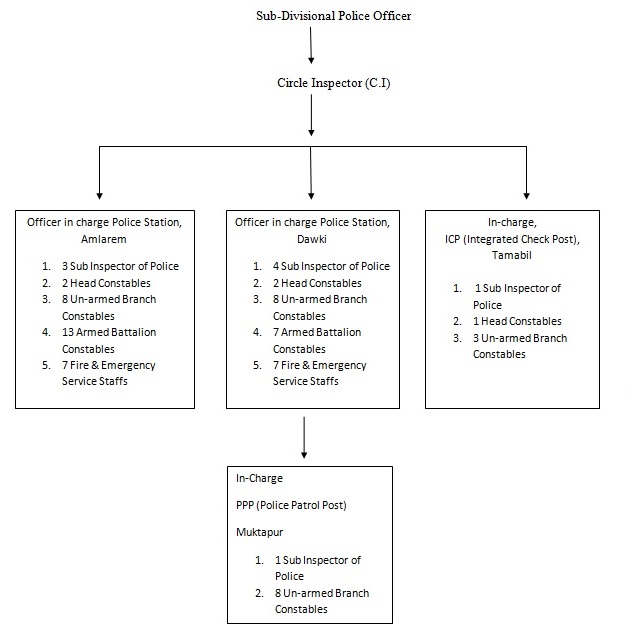
Organizational Chart of the Office of the Sub Divisional Police Officer (SDPO)
Powers and Responsibilities: The Real Deal Behind This Position
Understanding SDPO full form in police terminology goes beyond just knowing the expansion. Let’s explore what these officers actually do on a daily basis:
Administrative Powerhouse
An SDPO is essentially the CEO of their sub-division. They oversee multiple police stations, manage hundreds of personnel, and ensure that law and order mechanisms function smoothly. Think of them as conductors of a very complex orchestra where every musician (police officer) needs to be in perfect sync.
The administrative responsibilities include:
- Personnel management and deployment
- Budget allocation and resource optimization
- Performance monitoring of subordinate officers
- Implementation of government policies at the ground level
- Coordination with other departments and agencies
Operational Command Authority 🚨
The operational side of these responsibilities is where the real action happens! These officers are the first responders to major incidents in their jurisdiction. When there’s a serious crime, communal tension, or any law and order situation, the SDPO is the person who coordinates the response strategy.
Key operational powers include:
- Crime investigation supervision
- Preventive detention authority
- Crowd control and riot management
- Emergency response coordination
- Intelligence gathering and analysis
Judicial and Legal Powers ⚖️
Here’s where this position gets really interesting from a legal perspective. SDPOs have quasi-judicial powers, meaning they can make certain legal decisions without going through the court system. They can:
- Issue detention orders under preventive laws
- Grant or refuse permission for public gatherings
- Authorize searches and seizures
- Supervise investigation processes
- Coordinate with judicial authorities
Community Relations and Public Interface 🤝
Perhaps the most crucial aspect of the modern SDPO role is community engagement. Today’s Sub Divisional Police Officers are not just law enforcers; they’re community builders, mediators, and public servants who bridge the gap between the government and citizens.
Community-related responsibilities include:
- Public grievance redressal
- Community policing initiatives
- Awareness campaigns and public education
- Interfaith harmony and social cohesion efforts
- Media relations and public communication
Selection Process: The Journey to Becoming an SDPO
The path to holding the SDPO full form position is rigorous and highly competitive—definitely not for the faint-hearted! The selection process varies depending on whether you’re aiming for state police services or central services, but both routes demand dedication, preparation, and perseverance.
Educational Qualifications 📖
To be eligible for this position, candidates typically need:
- A bachelor’s degree from a recognized university
- Age limit usually between 21-35 years (varies by state and category)
- Physical fitness standards including height, chest, and endurance requirements
- Clean criminal background and character verification
Examination Pattern 📝
The journey involves multiple stages:
Written Examination: Usually consists of general studies, current affairs, law, and sometimes state-specific subjects. The questions test not just knowledge but analytical thinking and decision-making capabilities essential for this role.
Physical Standards Test: This isn’t just about running fast! The physical tests evaluate overall fitness, endurance, and the physical capability to handle the demanding nature of the responsibilities.
Interview/Personality Test: Perhaps the most crucial stage, where candidates’ suitability is assessed based on leadership qualities, ethical standards, communication skills, and overall personality.
Medical Examination: Comprehensive health checkups to ensure candidates can handle the physical and mental demands throughout their career.
Training and Preparation 🏃♂️
Once selected, future officers undergo extensive training that includes:
- Legal and constitutional knowledge
- Investigation techniques and forensic science
- Crisis management and disaster response
- Community policing and public relations
- Modern technology and digital crime investigation
- Physical training and weapons handling
- Leadership and management skills
Salary Structure: The Financial Rewards of This Position
Let’s talk money—because while serving the nation is noble, everyone needs to pay their bills! The salary structure for the SDPO full form position is quite attractive and comes with numerous perks, making it a financially rewarding career choice.
Basic Salary Components 💵
The starting salary for an SDPO with the rank of Deputy Superintendent of Police (DSP) is around INR 56,100 per month (excluding allowances and perks), with the basic pay for an entry-level IPS officer at the Junior Scale level being around INR 56,100 per month.
However, the total compensation package includes much more than just basic salary:
Basic Pay: ₹56,100 – ₹78,000 per month (varies by state and experience) Dearness Allowance (DA): Currently around 50% of basic pay House Rent Allowance (HRA): 24% to 30% depending on city classification Travel Allowance (TA): For official duties and transfers
Additional Perks and Benefits 🎁
This position comes with numerous non-monetary benefits that significantly enhance the overall compensation package:
Government Accommodation: Most SDPOs get official quarters, eliminating rent expenses Medical Benefits: Comprehensive healthcare for officer and family Vehicle and Fuel: Official vehicle with driver and fuel allowances Security: Personal security arrangements when required Pension Scheme: Attractive retirement benefits and gratuity Education Allowances: Support for children’s education Leave Travel Concession: Annual travel benefits for family
Promotion and Growth Prospects 📈
This position is not a career endpoint but a significant milestone in a police officer’s journey. With experience and performance, officers can progress to:
- Additional Superintendent of Police (Addl. SP): ₹67,700 – ₹2,08,700
- Superintendent of Police (SP): ₹78,800 – ₹2,09,200
- Deputy Inspector General (DIG): ₹1,44,200 – ₹2,18,200
- Inspector General (IG): ₹1,82,200 – ₹2,24,100
State-wise Variations: How This Position Differs Across India
India’s federal structure means that while the SDPO full form position maintains its core responsibilities across the country, interesting variations emerge in different states. This diversity makes the role even more fascinating from an administrative perspective.
Northern States Variation 🏔️
In the states of Rajasthan and Uttar Pradesh, the post is known as circle officer (CO), though the responsibilities and rank remain equivalent to the traditional Sub Divisional Police Officer. This nomenclature change reflects regional administrative preferences while maintaining functional consistency.
Uttar Pradesh: Circle Officers (CO) handle the same responsibilities as SDPOs in other states, but they often deal with unique challenges related to the state’s large population and diverse social dynamics.
Rajasthan: The CO system here is particularly well-developed, with specialized training programs for desert area policing and heritage site security.
Southern States Adaptation 🌴
Southern states have adapted this concept to suit their specific needs:
Karnataka and Telangana: In some states, the police circle system is prominently used, where these officers manage multiple circles with enhanced coordination mechanisms.
Tamil Nadu: The state has created specialized positions for coastal security, cyber crime, and industrial area policing.
Eastern and Western States 🌊
West Bengal: Officers here often deal with unique challenges related to border security with Bangladesh and managing diverse linguistic communities.
Maharashtra: Being India’s financial capital hub, Maharashtra’s officers receive specialized training in economic crime investigation and corporate fraud prevention.
Gujarat: The state has pioneered community policing initiatives, making this position more community-oriented.
Modern Challenges: SDPOs in the Digital Age
The 21st century has transformed policing, and the SDPO full form position has evolved to meet modern challenges head-on. Today’s Sub Divisional Police Officers are not only handling traditional law-and-order issues but also combating cyber threats, online fraud, and technology-driven crimes.
Cybercrime and Digital Investigations 🔒
Modern officers must be tech-savvy investigators who understand:
- Social media crime patterns and digital evidence collection
- Cryptocurrency-related offenses and blockchain investigation
- Online fraud, phishing, and identity theft cases
- Digital forensics and data recovery techniques
- Coordination with cyber security agencies and tech companies
Technology Integration 📱
The position now involves mastering various technological tools:
- Crime mapping and predictive policing software
- Digital case management systems
- Body-worn cameras and surveillance technology
- Mobile applications for citizen services
- Data analytics for crime pattern analysis
Social Media and Public Relations 📺
Today’s officers are public figures in the digital age, requiring:
- Social media management and online reputation handling
- Real-time communication during crisis situations
- Public awareness campaigns through digital platforms
- Handling viral incidents and managing public perception
- Coordinating with media houses and digital platforms
Career Prospects and Growth: Beyond This Position
The SDPO full form role serves as a launchpad for prestigious careers in law enforcement, public administration, and beyond. Many top-ranking police officers, administrators, and even politicians have started their journey from this position, making it one of the most promising roles in Indian policing.
Vertical Career Progression 📊
From this position, officers can climb the hierarchy through:
- Performance-based promotions: Exceptional work in crime control, community relations, and administrative efficiency
- Specialized training programs: Advanced courses in investigation, intelligence, and management
- Inter-cadre mobility: Opportunities to move between state and central services
- Deputation opportunities: Assignments with central agencies like CBI, Intelligence Bureau, or international organizations
Horizontal Career Opportunities 🔄
The experience opens doors to various specialized fields:
- Intelligence Services: RAW, Intelligence Bureau, and state intelligence departments
- Central Investigation Agencies: CBI, ED, NCB, and other specialized units
- Private Security Consulting: Post-retirement opportunities in corporate security
- Academia and Training: Teaching positions in police training institutes
- International Assignments: UN peacekeeping and diplomatic security roles
Entrepreneurial Ventures 💼
Many retired officers have successfully transitioned to:
- Security consulting firms
- Investigation and detective agencies
- Training and development companies
- Legal advisory services
- Technology solutions for law enforcement
Expert Insights: What Makes a Successful SDPO?
Based on interviews with senior police officers and administrative experts
According to retired DGP Rajesh Kumar Sinha, “The modern Sub Divisional Police Officer needs to be a perfect blend of traditional policing wisdom and contemporary management skills. They must be tech-savvy, emotionally intelligent, and culturally sensitive.”
Key Success Factors 🎯
Leadership Qualities: This position requires natural leadership abilities, including the capacity to inspire teams, make quick decisions under pressure, and maintain morale during challenging times.
Communication Skills: Modern SDPOs must be excellent communicators who can interact effectively with diverse stakeholders – from senior government officials to grassroots community members.
Adaptability: The rapidly changing nature of crime and society requires officers who can adapt quickly to new challenges and embrace innovative solutions.
Emotional Intelligence: Managing diverse teams and dealing with sensitive community issues requires high emotional intelligence and empathy.
Continuous Learning: Successful officers are lifelong learners who continuously update their knowledge and skills.
International Comparisons: SDPO in Global Context
This concept finds interesting parallels in police systems worldwide. Understanding these comparisons provides valuable insights into the uniqueness and effectiveness of the Indian system.
United Kingdom 🇬🇧
The UK’s Chief Inspector rank is somewhat comparable to this position, with similar responsibilities for managing multiple police stations and community relations.
United States 🇺🇸
American police departments have Captain or Deputy Chief positions that mirror some responsibilities, though the federal structure creates more variations.
Australia 🇦🇺
The Senior Sergeant or Inspector ranks in Australian police forces share operational similarities with this position.
Singapore 🇸🇬
Singapore’s Assistant Superintendent of Police role closely parallels this position in terms of responsibilities and hierarchical placement.
Future Outlook: The Evolution of This Role
This position is poised for significant transformation as India progresses toward becoming a developed nation by 2047. Several trends are shaping the future of this crucial role:
Technological Integration 🤖
Future officers will likely work with:
- Artificial Intelligence for crime prediction and resource allocation
- Drone technology for surveillance and crowd management
- Advanced forensic tools and real-time evidence processing
- Smart city integration and IoT-based security systems
- Virtual reality training and simulation programs
Specialized Roles 🎯
The position may evolve into specialized variants:
- Cyber Crime SDPO for digital crime management
- Economic Offences SDPO for financial crime investigation
- Community Relations SDPO for enhanced public engagement
- Border Security SDPO for frontier area management
- Counter-Terrorism SDPO for security threat mitigation
Enhanced Training Programs 📚
Future preparation will include:
- International best practices and cross-cultural policing
- Advanced data analytics and machine learning applications
- Conflict resolution and mediation techniques
- Mental health awareness and stress management
- Environmental crime and climate change adaptation
Common Misconceptions About This Position
Let’s bust some myths and clarify common misconceptions:
Myth 1: “SDPO is just another bureaucratic position”
Reality: This position is highly operational, requiring hands-on involvement in crime investigation, community relations, and emergency response.
Myth 2: “SDPOs only handle rural areas”
Reality: These officers serve in both urban and rural jurisdictions, with responsibilities adapted to local needs and challenges.
Myth 3: “The position offers limited career growth”
Reality: This role is a stepping stone to senior positions in police hierarchy and offers diverse career opportunities.
Myth 4: “Technology has reduced the importance of SDPOs”
Reality: Technology has actually enhanced the role, providing better tools for crime prevention and investigation while requiring higher skills.
Tips for Aspiring Officers
If you’re inspired to pursue this career path, here are some practical tips from successful officers:
Academic Preparation 📖
- Focus on current affairs and constitutional knowledge
- Develop strong analytical and writing skills
- Study criminology and police science
- Learn about technology applications in law enforcement
- Understand social psychology and community dynamics
Physical Fitness 💪
- Maintain consistent fitness routines
- Practice endurance exercises and stress management
- Learn basic self-defense and weapon handling
- Develop mental resilience and emotional stability
Personality Development 🌟
- Cultivate leadership and team management skills
- Practice public speaking and communication
- Develop cultural sensitivity and social awareness
- Build ethical foundations and integrity
- Learn conflict resolution and negotiation techniques
Conclusion:
The SDPO full form stands for Sub Divisional Police Officer, a key mid-level leadership role in India’s police system. SDPOs oversee multiple police stations, manage law and order, supervise investigations, and coordinate emergency responses within their jurisdiction. Holding the rank of Deputy Superintendent of Police (DSP), they blend administrative authority with operational responsibilities, including community engagement and legal powers.
The blog covers SDPO history, recruitment process, salary structure, state-wise variations, modern digital challenges, career growth opportunities, and expert insights. It also explains how SDPOs are evolving with technology, handling cybercrime, and adapting to changing security needs while remaining vital in maintaining law and order across India.
For readers interested in exploring related administrative topics, don’t miss our detailed guide on the CERSAI Full Form and its role in India’s financial ecosystem.
Frequently Asked Questions
1. What is the exact SDPO full form and what does it mean?
A: The SDPO full form is “Sub Divisional Police Officer.” It refers to a senior police officer responsible for managing a police sub-division, which typically includes multiple police stations and covers a significant geographical area.
2. What is the SDPO full form in Hindi?
A: The SDPO full form in Hindi is “उप-विभागीय पुलिस अधिकारी” (Up-Vibhagiya Police Adhikari), which translates directly to Sub Divisional Police Officer.
3. Is there any difference between SDPO and SDOP ?
A: SDOP full form appears to be a typographical error. The correct term is SDPO full form (Sub Divisional Police Officer). There is no official position called SDOP in the Indian police system.
4. What rank does an SDPO officer hold?
A: An SDPO officer typically holds the rank of Deputy Superintendent of Police (DSP) or Assistant Superintendent of Police (ASP), making them gazetted officers with significant administrative and operational powers.
5. How is the SDPO in police hierarchy different from other positions?
A: The SDPO full form in police hierarchy represents a mid-level leadership position. SDPOs report to Superintendent of Police (SP) and supervise Circle Inspectors, Inspectors, and other junior officers across multiple police stations.
Curious about more interesting abbreviations and their meanings? Explore our complete collection at All Type Full Form for full forms across every field.