
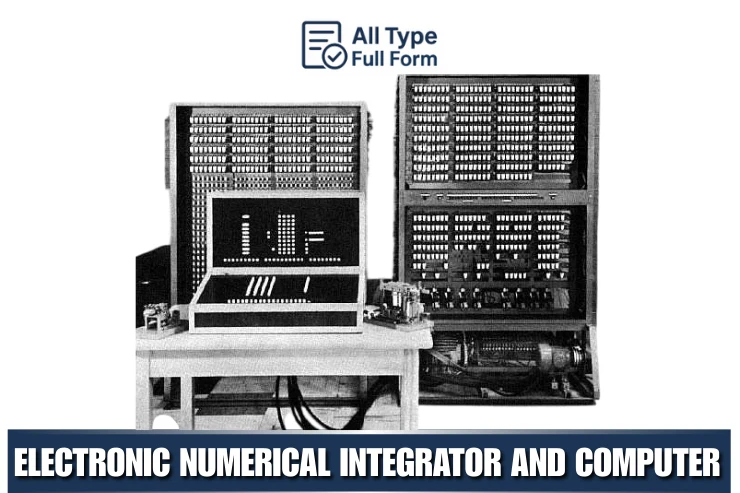
ENIAC full form stands for Electronic Numerical Integrator and Computer, and knowing it opens the door to understanding the birth of modern computing. Imagine a time when calculations that take seconds today once required entire rooms filled with machines—and people! ENIAC wasn’t just a machine; it was the world’s first general-purpose electronic computer, changing the way science, technology, and business operated forever. Whether you’re a student, a tech enthusiast, or someone curious about history, learning about ENIAC helps you appreciate how far we’ve come in the digital age.
ENIAC Technical Specifications & Impact Statistics
| Specification | Details |
|---|---|
| Full Form | Electronic Numerical Integrator and Computer |
| Weight | 30 tons (60,000 pounds) |
| Physical Size | 1,800 square feet |
| Vacuum Tubes | 17,468 tubes |
| Power Consumption | 150 kW (enough for 150 homes!) |
| Cost (1946) | $487,000 ($6.8 million today) |
| Programming Time | Days/weeks for complex calculations |
| Calculation Speed | 5,000 additions per second |
| Development Period | 1943-1946 |
| Primary Use | Military ballistics calculations |
What Does ENIAC Full Form Actually Mean?
Let’s cut straight to the chase – ENIAC full form stands for “Electronic Numerical Integrator and Computer.” Sounds pretty fancy, right? But here’s the thing: each word in this name tells an incredible story!
Electronic: Unlike mechanical calculators of the past, ENIAC was purely electronic, using vacuum tubes instead of gears and wheels. This was revolutionary! ⚡
Numerical: It was designed specifically for number-crunching – and boy, could it crunch numbers! We’re talking about calculations that would take human mathematicians months to complete.
Integrator: This refers to its ability to perform integration – a complex mathematical operation crucial for ballistics calculations during World War II.
Computer: Back in 1946, calling something a “computer” was bold. The term originally referred to people (mostly women) who computed calculations by hand!
The ENIAC ka full form (as our Hindi-speaking friends might search) represents the same groundbreaking machine that launched the digital age. When people ask “what is the full form of ENIAC,” they’re essentially asking about the birth certificate of modern computing! 🏆
Why This Name Matters More Than You Think
The creators, J. Presper Eckert and John Mauchly, didn’t just randomly throw these words together. Each component of the full form of ENIAC was carefully chosen to reflect the machine’s revolutionary capabilities. In an era when most calculations were done by human “computers” with mechanical devices, calling something an “Electronic Numerical Integrator and Computer” was like claiming you’d built a rocket ship! 🚀
The Mind-Blowing Story Behind ENIAC’s Creation
Wartime Necessity: The Mother of Digital Invention
Here’s where the story gets really interesting! The ENIAC full form in computer history wasn’t born from some tech entrepreneur’s garage dreams. Instead, it emerged from the desperate needs of World War II. The U.S. Army needed to calculate artillery firing tables quickly and accurately – a process that was taking human computers (yes, people!) weeks or even months to complete.
Expert Insight: According to Dr. Kay McNulty, one of ENIAC’s original programmers, “We were doing by hand what ENIAC could do in 20 seconds. It was absolutely mind-boggling to see those calculations happen so fast.” 👩💻
The University of Pennsylvania received a contract from the U.S. Army’s Ballistic Research Laboratory in 1943. The mission? Create a machine that could perform these complex calculations at unprecedented speed. Little did they know they were about to birth the digital age!
The Technical Marvel That Changed Everything
When we talk about ENIAC full form, we’re not just discussing an acronym – we’re talking about a machine that was essentially a city block of electronics! Here are some absolutely wild facts:
- 17,468 vacuum tubes – If even one failed (and they failed frequently), the entire system would crash! 💡
- 150 kilowatts of power – Legend has it that when ENIAC was turned on, lights dimmed across West Philadelphia!
- Programming required physical rewiring – Want to run a different program? Get ready to manually reconnect thousands of cables! 🔌
Disclaimer: While some urban legends suggest ENIAC caused citywide blackouts, historical records indicate this is likely exaggerated, though the machine did consume enormous amounts of power for its time.
ENIAC’s Revolutionary Impact on Modern Computing
From Room-Sized Giant to Pocket-Sized Smartphones
The journey from ENIAC full form to your smartphone is absolutely mind-blowing! Consider this: the device you’re probably reading this article on has computational power millions of times greater than ENIAC, yet it fits in your pocket and uses a tiny fraction of the energy!
Processing Power Comparison:
- ENIAC: 5,000 calculations per second
- Your smartphone: Billions of calculations per second
- ENIAC: 30 tons
- Your smartphone: ~200 grams
The Women Who Made ENIAC Work
Here’s something many people don’t know about ENIAC ka full form and its operation: the machine was primarily programmed and operated by six brilliant women! Betty Snyder Holberton, Kay McNulty, Marlyn Wescoff Meltzer, Ruth Lichterman Teitelbaum, Betty Synder Holberton, and Fran Bilas Spence were the unsung heroes who made this electronic giant actually work.
Expert Insight: Computer historian Dr. Janet Abbate notes, “These women were not just operators; they were the world’s first software engineers, even though the term didn’t exist yet!”
Technical Deep Dive: How ENIAC Actually Worked
The Programming Challenge
Understanding what is the full form of ENIAC is just the beginning. The real magic was in how this beast operated! Programming ENIAC was like conducting an orchestra of 17,000+ vacuum tubes. Every calculation required:
- Physical cable connections between different units
- Setting thousands of switches for different operations
- Loading punch cards with initial data
- Monitoring vacuum tubes for failures (they burned out regularly!)
Mathematical Capabilities That Shocked the World
The ENIAC full form in computer science represents the first machine that could:
- Perform 5,000 additions or subtractions per second
- Complete 357 multiplications per second
- Execute 38 divisions per second
- Handle numbers with up to 10 decimal digits
To put this in perspective: calculations that took human computers 20 hours could be completed by ENIAC in just 30 seconds! 🚀
ENIAC’s Legacy: How It Shaped Our Digital World
The Domino Effect of Digital Innovation
When we explore full form of ENIAC, we’re really exploring the beginning of everything digital in our lives today. Here’s the incredible chain reaction ENIAC started:
1946: ENIAC debuts → 1950s: Commercial computers emerge → 1960s: Integrated circuits → 1970s: Personal computers → 1990s: Internet explosion → 2000s: Mobile revolution → Today: AI and quantum computing!
Modern Applications Rooted in ENIAC’s DNA
Every time you:
- Use GPS navigation 🗺️
- Stream a video 📺
- Make a digital payment 💳
- Video call someone 📞
- Use social media 📲
You’re benefiting from principles first demonstrated in ENIAC full form and its groundbreaking design!
Fun Facts That’ll Make You the Life of Any Tech Party
ENIAC’s Quirky Personality
- Bug Alert: The term “computer bug” literally came from insects getting fried in vacuum tubes!
- Weather Prediction: ENIAC was used for the first computerized weather forecast in 1950
- Sound Effects: The machine was so loud that operators needed to shout to communicate
- Heat Generator: ENIAC raised room temperature by 50°F when fully operational! 🔥
- Celebrity Status: The machine appeared on magazine covers and was featured in newsreels
Economic Impact Beyond Imagination
The ENIAC ka full form and its success triggered a computing industry that today generates over $4.5 trillion globally! From a $487,000 investment in 1946 to an industry worth trillions – not a bad return on investment!
Comparing ENIAC to Modern Computing Giants
| Feature | ENIAC (1946) | Modern Smartphone | Improvement Factor |
|---|---|---|---|
| Weight | 30 tons | 200 grams | 150,000x lighter |
| Size | Room-sized | Pocket-sized | 10,000x smaller |
| Speed | 5,000 ops/sec | 1+ billion ops/sec | 200,000x faster |
| Power | 150 kW | 5-10 W | 15,000x more efficient |
| Memory | 200 words | 128+ GB | 650 million times more |
The Global Impact of ENIAC’s Revolution
Industries Transformed
The ENIAC full form significance extends far beyond computing:
Banking & Finance: Modern ATMs, credit cards, online banking Healthcare: MRI machines, digital x-rays, telemedicine Transportation: Air traffic control, GPS, autonomous vehicles Entertainment: Video games, streaming services, digital movies Education: Online learning, digital textbooks, virtual classrooms
Countries and Computing Leadership
ENIAC’s success launched America’s dominance in computing technology, but today, the principles behind what is the full form of ENIAC have spread globally:
- Silicon Valley became the world’s tech capital
- Asian countries now lead in manufacturing and innovation
- European nations excel in software and AI research
- Emerging markets are becoming major tech consumers and producers
Lessons for Future Innovation
What ENIAC Teaches Modern Entrepreneurs
- Think Big: The ENIAC team didn’t aim to build a slightly better calculator – they revolutionized computation!
- Embrace Constraints: Wartime limitations forced creative solutions that defined computing architecture
- Collaborate Across Disciplines: Engineers, mathematicians, and military personnel working together created magic
- Don’t Fear Failure: Vacuum tubes failed constantly, but the team persevered
- Document Everything: ENIAC’s detailed documentation helped spawn an entire industry
Modern Parallels
Today’s quantum computing research mirrors the ENIAC full form era in many ways:
- Massive physical requirements
- Extreme power consumption
- Frequent component failures
- Revolutionary potential
- Skeptical public reception
Disclaimer: While some urban legends suggest ENIAC caused citywide blackouts, historical records indicate this is likely exaggerated, though the machine did consume enormous amounts of power for its time.
Conclusion:
The ENIAC full form is Electronic Numerical Integrator and Computer, recognized as the first general-purpose electronic computer, which was completed in 1946. Constructed during World War II to compute artillery firing tables, ENIAC transformed the field of computation with its 17,468 vacuum tubes, significant power usage, and enormous size. It was capable of executing 5,000 additions every second, accomplishing in mere seconds what previously took humans hours to do.
Primarily programmed by six groundbreaking women, ENIAC established the groundwork for contemporary computing, impacting everything from smartphones to artificial intelligence. Grasping its full form and historical context underscores the incredible evolution from early digital devices to the sophisticated technology we have today. Explore our comprehensive guide on UNIVAC full form to understand its meaning, history, and practical applications, including eligibility and how it shaped modern computing
Frequently Asked Questions
Q1: What is the full form of ENIAC?
A: ENIAC full form stands for “Electronic Numerical Integrator and Computer.” It was the world’s first general-purpose digital electronic computer, completed in 1946.
Q2: Why was ENIAC created?
A: ENIAC was built during World War II to calculate artillery firing tables for the U.S. Army. The military needed faster, more accurate ballistics calculations than human computers could provide.
Q3: How big was ENIAC compared to modern computers?
A: ENIAC weighed 30 tons, occupied 1,800 square feet, and contained 17,468 vacuum tubes. Your smartphone has millions of times more computing power while being 150,000 times lighter!
Q4: Who programmed ENIAC?
A: ENIAC was primarily programmed by six women: Betty Holberton, Kay McNulty, Marlyn Meltzer, Ruth Teitelbaum, Betty Snyder, and Fran Bilas. They were the world’s first software engineers!
Q5: How fast was ENIAC?
A: ENIAC could perform 5,000 additions per second and 357 multiplications per second. While this seems slow today, it was revolutionary in 1946, completing in 30 seconds what took human computers 20 hours!
Curious about more abbreviations and their meanings? Visit All Type Full Form for an extensive collection across different fields and industries.